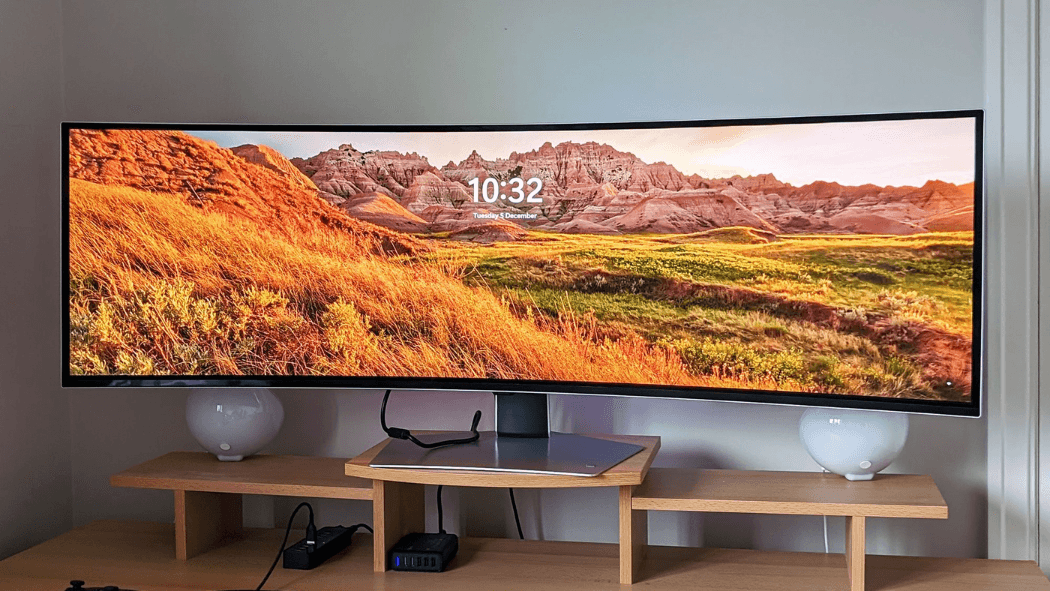
Display Technology & Panel Specifications
The Samsung Odyssey G93SC represents a significant leap in ultrawide gaming monitor technology. At its core sits a QD-OLED panel—a hybrid technology that merges OLED’s infinite contrast capabilities with Quantum Dot color precision.
This combination delivers exceptional visual clarity without sacrificing the deep blacks that define true OLED performance.
The monitor’s 49-inch screen spans a 32:9 aspect ratio, effectively providing the workspace of two 27-inch QHD monitors positioned side-by-side. Resolution reaches 5120 × 1440 pixels, maintaining a pixel density of approximately 108 PPI.
The 1800R curve wraps around the viewer’s field of vision, creating genuine immersion rather than serving as a cosmetic feature.
Technical Color Performance
Color accuracy reaches professional-grade standards with 10-bit color depth and a gamut covering 100% sRGB and 99.5% DCI-P3. Brightness measures around 250 nits typically, while the contrast ratio hits an impressive 1,000,000:1—a direct result of OLED’s pixel-level light control. Viewing angles extend to 178° both horizontally and vertically, ensuring consistent image quality from virtually any position in front of the screen.
Gaming Performance Capabilities
For competitive gaming, the G93SC delivers responsiveness that few monitors match. The 240Hz refresh rate pairs with a 0.03ms gray-to-gray response time, eliminating motion blur and input lag that plague slower displays.
Support for both AMD FreeSync Premium Pro and NVIDIA G-Sync Compatible means adaptive synchronization works seamlessly regardless of GPU choice, effectively erasing screen tearing artifacts.
DisplayHDR True Black 400 certification signals genuine HDR support, leveraging OLED’s contrast advantage to render highlights and shadows with precision. The monitor includes Samsung’s OLED Safeguard technology, designed to mitigate burn-in risk through various protective mechanisms—a practical consideration given OLED’s historical vulnerability to static imagery.
Connectivity & Physical Design
Connection options include DisplayPort 1.4, dual HDMI 2.1 ports, a USB 3.2 Gen1 hub, and a headphone jack. This combination covers virtually all contemporary gaming systems and allows daisy-chaining additional peripherals through the USB functionality.
The physical construction emphasizes minimalism and durability. The OLED panel measures just 4.5mm at its thinnest point, creating an almost impossibly thin visual footprint. A premium metallic chassis frames the display, while the adjustable stand provides height adjustment and tilt flexibility. VESA mounting compatibility (100 × 100) opens possibilities for arm-mounted configurations on larger desks.
Dimensions & Spatial Requirements
The monitor spans 1194.7mm (47.0 inches) in width, 365mm in height, and 180.8mm in depth. Weighing approximately 9.2kg (20.3 lbs), it’s surprisingly light given its massive screen size. However, the width requirement means this display demands serious desk real estate—a consideration that shouldn’t be overlooked during purchasing decisions.
Practical Advantages & Limitations
The ultrawide format excels for specific use cases. Flight simulators, racing games, and space sims benefit enormously from the panoramic field of view. Content creators and financial analysts find multitasking efficiency gains substantial, as the 32:9 layout accommodates multiple applications simultaneously without window arrangement complications.
The 240Hz refresh rate with 0.03ms response time serves competitive gaming well, particularly for fast-paced titles where reaction times matter. However, this monitor demands modern GPU hardware to consistently achieve high framerates—systems with older graphics cards will struggle to fully leverage these specifications.
The OLED panel delivers uncompromising image quality, but requires awareness of burn-in precautions. Users accustomed to static UI elements or logos should employ screen savers and rotate content regularly.
The premium pricing reflects both the technology involved and the limited market of ultrawide gaming enthusiasts. Additionally, the sheer size means it isn’t practical for everyone—smaller desks or shared spaces present installation challenges that no amount of quality can overcome.
Suitable Use Cases & User Profile
The G93SC aligns best with enthusiasts who combine gaming with productivity work. Sim racing enthusiasts specifically benefit from the immersive width. Flight simulator pilots gain practical advantages from the expanded forward view. Professional traders and data analysts appreciate the multitasking potential.
Casual gamers playing standard competitive shooters or MOBAs won’t necessarily see proportional benefit from the ultrawide format. Standard gaming desks may struggle to accommodate the 1.2-meter width comfortably. Users with mid-range GPU hardware won’t reach the monitor’s 240Hz ceiling, limiting their ability to fully utilize its performance specifications.
Standard Package Contents
The retail box includes the Odyssey G93SC monitor itself, the adjustable stand, power cable, HDMI cable, DisplayPort cable, and user documentation. This straightforward inclusion means buyers need to source only additional cables if upgrading existing systems.
Verdict
The Samsung Odyssey G93SC is one of the most advanced ultrawide gaming monitors available. Its QD-OLED panel, 240Hz refresh rate, and huge 32:9 display create a near-cinematic gaming experience while also functioning as a powerful multitasking workstation display. It’s best suited for enthusiasts who want a premium immersive setup and have the desk space and GPU power to drive it.