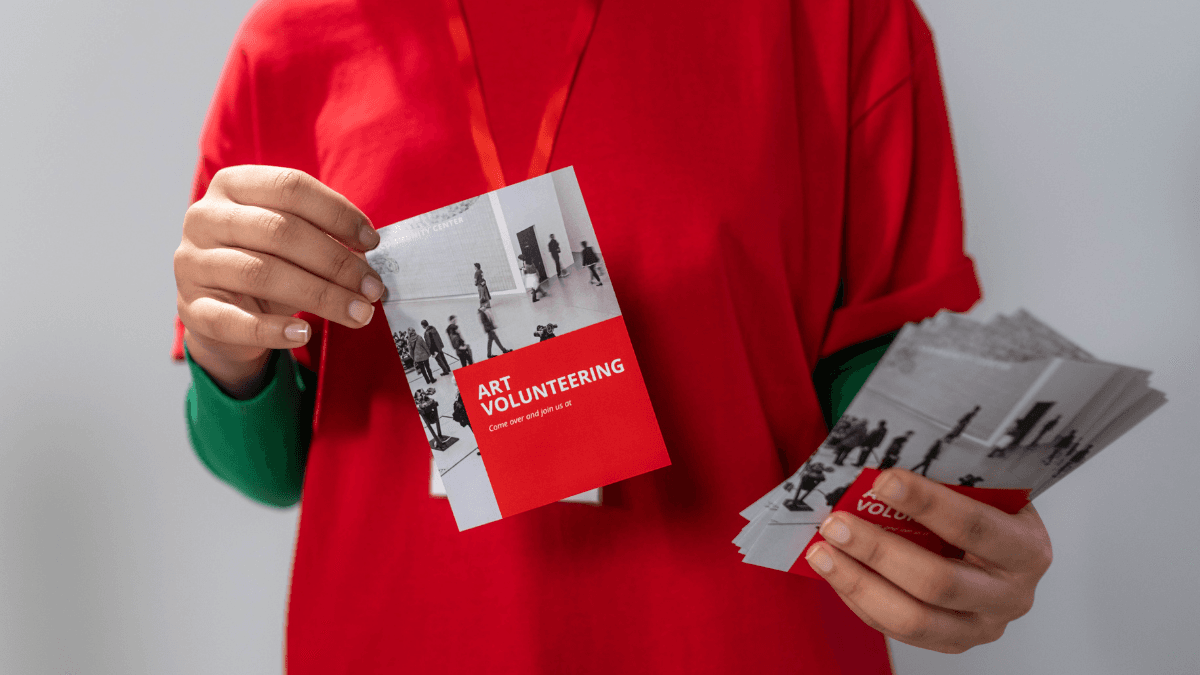
Flyers and brochures are both useful printed marketing materials, but they aren’t interchangeable. A flyer typically delivers one focused message quickly, while a brochure provides more room to organize detailed information into sections.
Choosing between them starts with understanding what you need to communicate, how your audience will receive the material, and what you want readers to do next.
What Is a Flyer?
A flyer is generally a single printed sheet designed for quick communication. It may be printed on one or both sides and is commonly used for promotions, events, openings, local services, sales, and announcements.
Effective flyers usually feature a clear headline, concise supporting information, relevant imagery, contact details, and a strong call to action.
Because people may only look at a flyer briefly, the main message should be immediately apparent.
What Is a Brochure?
A brochure provides more space for information and often uses folded panels to organize its content.
Bi-fold and tri-fold formats can separate information into sections covering services, features, frequently asked questions, background information, and next steps. This makes brochures useful when potential customers need more context before making a decision.
When a Flyer Works Best
A flyer may be a good choice when your campaign emphasizes simplicity, reach, and immediate communication.
Flyers can work particularly well for:
- Events and announcements
- Seasonal promotions
- New services or openings
- Local campaigns
- Simple offers
- Short-term messages
They can be distributed at events, included with purchases, displayed in permitted locations, or used in other appropriate distribution channels.
When a Brochure Works Best
A brochure can make more sense when your audience needs time to evaluate detailed information.
For example, you might use a brochure to explain several services, outline a process, present product categories, answer common questions, or support an in-person consultation.
The additional space can accommodate photographs, diagrams, specifications, and explanations that would make a flyer feel overcrowded.
Compare the Design Requirements
Flyers generally require strong visual hierarchy. Your headline and primary message should attract attention quickly, followed by only the information necessary to encourage the next step.
Brochures require an additional layer of planning because readers encounter information in a sequence. Fold positions, panel order, margins, graphics, and text placement all influence readability.
Whichever format you choose, avoid filling every available space. White space can make important information easier to find.
Think About Distribution
How customers receive the material should influence your choice from the beginning.
Flyers are often practical for high-volume handouts, events, counter displays, packaging inserts, and permitted community boards. Brochures can work particularly well in consultations, sales meetings, trade shows, waiting areas, or information racks where people expect to spend more time reading.
If you’re mailing either format, check applicable postal specifications before finalizing dimensions and printing.
Consider Cost and Longevity
A simple flyer may involve fewer production steps than a folded brochure, but neither format is automatically cheaper.
Costs depend on paper, dimensions, print quantity, color, finishing, folding, coating, and other production choices. Compare equivalent specifications when requesting estimates.
Also consider how long the information will remain relevant. Flyers are often suited to short-term campaigns, while brochures containing general service information may remain useful longer.
Avoid printing excessive quantities when prices, schedules, services, or other details change frequently.
Avoid Common Design Mistakes
A flyer can quickly become difficult to read when it contains too much text, several competing headlines, numerous fonts, weak contrast, or too many calls to action.
Brochures have different challenges. Poorly planned folds can separate related information or make the reading order confusing. Filling every panel with dense copy can also defeat the purpose of having additional space.
Can You Use Both?
Absolutely. Flyers and brochures can serve different stages of the same marketing campaign.
A flyer might attract attention to an event or service, while a brochure available at the location provides additional details. Maintaining consistent typography, imagery, and visual styling can help the materials feel connected.
Match the Format to Your Message
Choose a flyer when you have one concise message that people should understand quickly. Choose a brochure when your audience needs several sections of information before deciding what to do next.
Consider your audience, content volume, distribution method, expected lifespan, budget, and desired call to action.
Ultimately, the better marketing material isn’t the one with more space or a more elaborate finish. It’s the format that communicates your message clearly and makes it easy for customers to take the next step.