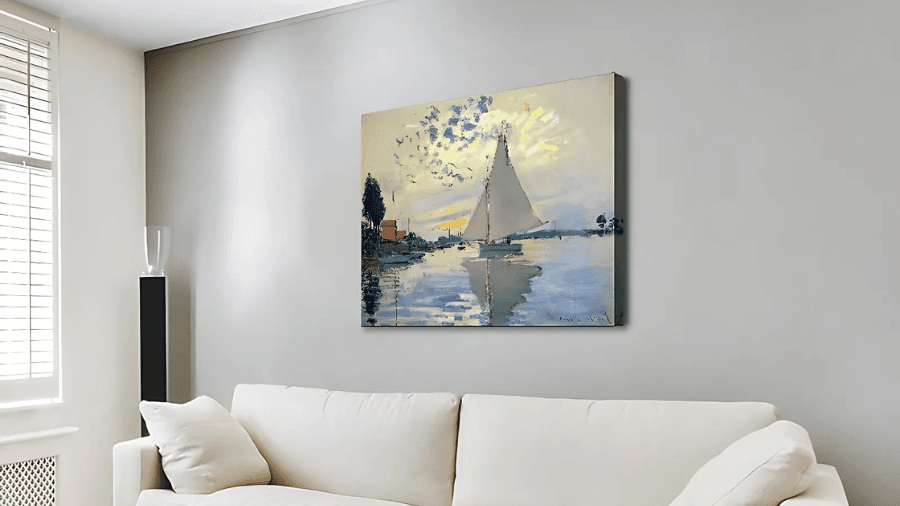
The allure of “Sailboat at Le Petit-Gennevilliers” transcends time, speaking to our universal appreciation for tranquility and natural beauty. Whether admired in Dublin’s National Gallery or as a thoughtfully placed reproduction in your home, this masterpiece continues to evoke the sensory experience Monet intended—a moment of peace captured on the Seine nearly 150 years ago.
The Enchanting World of Monet’s Sailboat
Claude Monet’s 1874 masterpiece “Sailboat at Le Petit-Gennevilliers” captures a single, magical moment on the Seine with extraordinary sensitivity. This 55 × 65 cm oil on canvas work freezes time yet paradoxically conveys movement through Monet’s revolutionary approach to light, color, and water’s fluid nature.
While Monet once remarked, “I perhaps owe having become a painter to flowers,” his river scenes reveal an equally profound connection to water as a subject of endless fascination. This piece coincided with the first Impressionist exhibition, marking a pivotal moment when these revolutionary artists formally challenged academic painting traditions.
Today, this treasure resides at the National Gallery of Ireland, where it was bequeathed in 1924 after being acquired in 1899, continuing to enchant visitors with its timeless beauty and emotional resonance.
The Artistic Brilliance Behind the Canvas
Signature Brushwork Creating Living Light
Monet’s distinctive broken brushstrokes transform what could be static paint into a dynamic, shimmering experience. Rather than depicting water and sky as fixed elements, his technique creates the illusion of light dancing across the river’s surface—constantly in motion despite the fixed medium.
Harmonious Composition and Color
The composition masterfully balances a solitary white-sailed boat against the expansive sky and reflective Seine. This relationship between the small human element and the vast natural world creates both visual interest and philosophical contemplation about our place in nature.
The palette speaks in hushed tones—soft blues and grays mingling with muted yellows—creating an atmosphere of tranquil contemplation. Strategic touches of red from distant riverside buildings provide just enough visual contrast to prevent the serenity from becoming monotonous, demonstrating Monet’s intuitive understanding of color psychology.
This work perfectly exemplifies Monet’s extraordinary ability to capture atmospheric conditions—not merely showing a boat on water, but evoking the very feeling of being present in that moment, with all its sensory qualities intact.
Monet’s Argenteuil Period: Context and Significance
Life Along the Seine
The painting emerged during Monet’s especially productive Argenteuil period (1871-1878), when he immersed himself in riverside living. This intimate connection with the Seine wasn’t merely observational—Monet frequently painted from a floating studio, giving him perspectives that shore-bound artists could never access and developing a profound relationship with water’s changing character.
The Seine region provided Monet with infinite variations of the same subject, allowing him to develop his fascination with how light and reflection transform familiar scenes throughout different times and conditions.
Historical Watershed Moment
The painting’s creation in 1874 coincides precisely with the inaugural exhibition of the Impressionist movement in Paris. This timing places “Sailboat at Le Petit-Gennevilliers” at the epicenter of one of art history’s most significant revolutions.
Beyond purely artistic importance, the work subtly documents the social context of France’s industrial revolution. The leisurely sailing activities depicted represent the emerging middle-class pursuit of recreational activities along the industrializing Seine—capturing not just visual beauty but sociological transformation.
Technical Mastery and Artistic Innovation
Revolutionary Approach to Visual Perception
Monet fundamentally rejected academic traditions of detailed representation in favor of capturing light effects—asking viewers to participate in completing the visual experience rather than presenting a finished illusion. This approach mirrors emerging scientific understandings about how human visual perception actually works.
His application of paint in small, visible brushstrokes represents a radical departure from the smooth, invisible technique valued in traditional painting. These marks, once considered unfinished or crude, reveal Monet’s understanding that our eyes naturally blend these impressions into coherent wholes.
Mastery of Water’s Complexity
The painting demonstrates Monet’s exceptional observational skills regarding how changing light transforms color throughout the day. Rather than depicting water as a single blue, he incorporates reflections of sky, atmospheric conditions, and surrounding landscape.
Most impressive is Monet’s ability to convey movement through seemingly static brushwork. The water appears to ripple and flow through careful manipulation of tone and direction, creating an almost cinematic quality decades before film existed.
Collecting Monet: Finding Quality Reproductions
Premium Print Options
Giclée prints from established art reproduction services like Art.com and AllPosters offer exceptional color fidelity across sizes ranging from intimate 12×9″ pieces suitable for small spaces to dramatic 56×42″ statement works. Canvas reproductions provide textural qualities that echo the original oil painting’s dimensional brushwork.
Accessible Art for Every Budget
For those seeking affordable options, Amazon’s PosterFoundry sells 36×24″ prints for approximately $20, making this masterpiece accessible for home décor. Granger Art on Demand specializes in archival poster paper with elegant white borders that complement the composition.
Etsy artisans offer personalized reproductions with prices ranging from $10 to $65, often with custom framing options or unique presentations that commercial retailers cannot match.
When selecting frames for your Monet reproduction, consider options that complement his delicate color palette—natural woods or simple white frames often enhance rather than compete with the artwork. Quality reproductions preserve the subtle nuances of Monet’s brushwork and delicate color transitions, ensuring your connection to this masterpiece remains authentic despite being a reproduction.
The Enduring Appeal of Monet’s Maritime Vision
The allure of “Sailboat at Le Petit-Gennevilliers” transcends time, speaking to our universal appreciation for tranquility and natural beauty. Whether admired in Dublin’s National Gallery or as a thoughtfully placed reproduction in your home, this masterpiece continues to evoke the sensory experience Monet intended—a moment of peace captured on the Seine nearly 150 years ago. As you contemplate adding this iconic image to your collection, remember you’re not just acquiring a decoration but embracing a piece of artistic history that revolutionized how we perceive the world around us.